

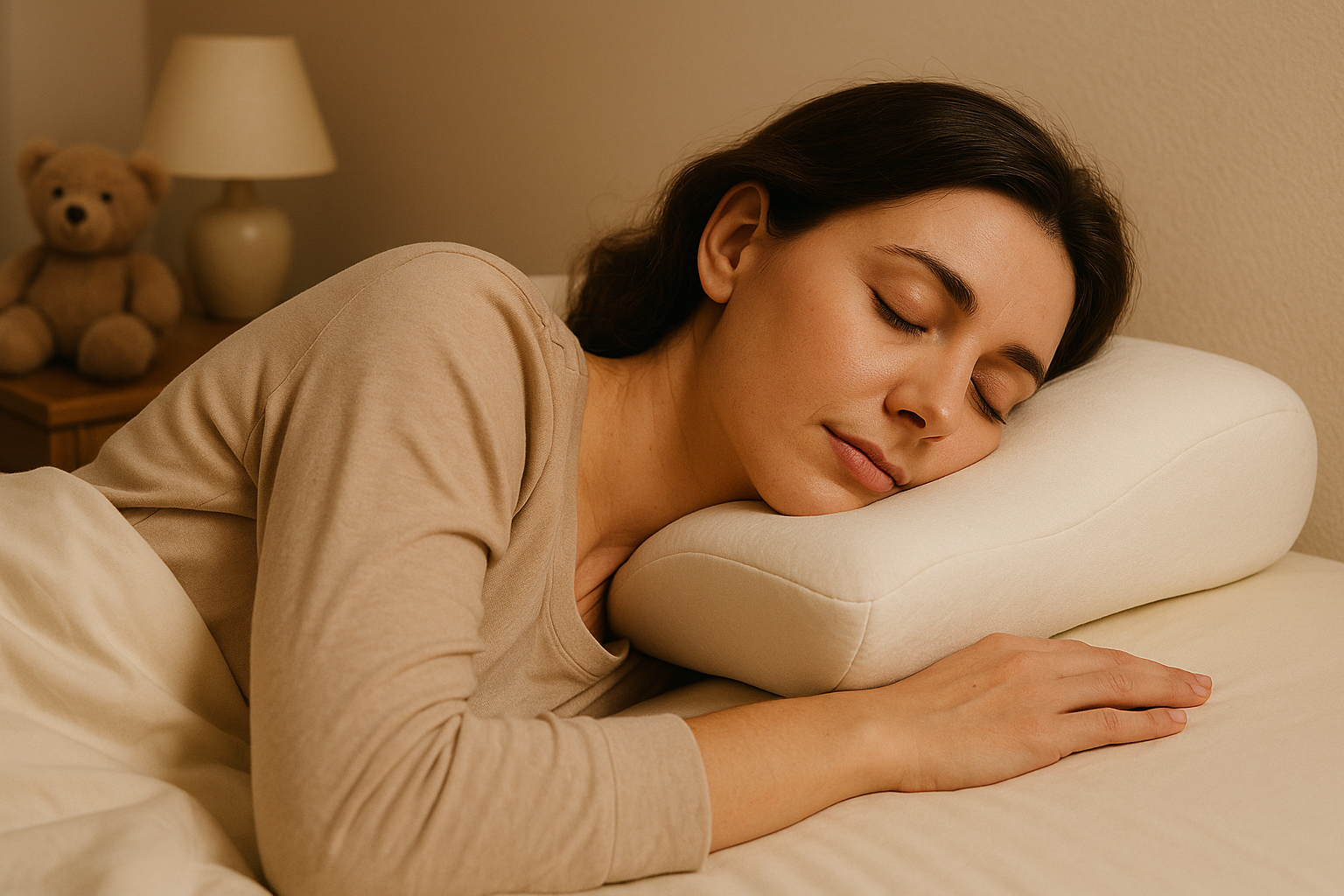
Sleeping on your back is often presented as the benchmark position for sleep, especially when the goal is to reduce neck tension and encourage better spinal alignment. Yet this position is truly beneficial only if the cervical support is suitable. A pillow that is too high, too flat, or poorly shaped can flatten the neck’s natural curve, create pressure points, and leave you feeling stiff in the morning.
The real challenge, then, is choosing a pillow for sleeping on your back that supports the head without pushing the chin toward the chest, and supports the neck without letting it “fall” backward. At Sleepit, this balance between Italian craftsmanship and ergonomic science guides every design: expert hands shape pillows designed to respect the real anatomy of sleepers.
If you want to better understand the mechanics of nighttime alignment, you can also read our article on cervical alignment during sleep, as well as our scientific studies dedicated to ergonomic support.
The benefits and limits of sleeping on your back
Back sleeping offers several advantages when properly supported by bedding. In principle, it allows for a more even distribution of body weight and can reduce certain mechanical stresses on the shoulders and spine.
Why this position can help the neck
When you sleep on your back, the head, neck, and upper back can remain in a relatively neutral axis. This is especially helpful for people who suffer from sensitive back-sleeping cervical posture, morning muscle tension, or fatigue in the upper back.
Ergonomic data points in this direction: the ErgoCert certification of Sleepit pillows confirmed a design that promotes alignment of the cervical vertebrae, with a 40% reduction in pressure points compared with a standard pillow. In a clinical study conducted over 12 weeks with adults suffering from chronic neck pain, the use of an ergonomic pillow was associated with a 62% reduction in pain and a clear improvement in sleep quality.
The limits to be aware of
Sleeping on your back is not automatically ideal. It can become problematic if:
- the pillow is too thick and pushes the head forward;
- the neck is not supported and ends up “hanging” without support;
- the shoulders rise toward the ears because of incorrect height;
- the sleeper twists during the night.
In other words, the benefit does not come only from the position, but from the way the body is set in it. To explore the design logic behind these solutions in more depth, discover Sleepit’s Innovation page.
What pillow shape helps preserve the cervical curve
A good back-sleeper pillow should neither overfill the space under the head nor leave the neck without support. The goal is to preserve the natural cervical lordosis, meaning the slight physiological curve of the neck.
The most suitable shape
For sleeping on your back, the most interesting shape is often an ergonomic structure with:
- more pronounced support under the neck;
- a slightly lower area under the back of the head;
- a material that can adapt without collapsing too quickly.
This geometry supports the neck while preventing the head from being pushed forward. That is precisely the logic behind a well-designed ergonomic pillow: it follows the body’s curves rather than forcing them.
Why density matters as much as shape
Shape alone is not enough. A well-designed pillow that is too soft can lose its effectiveness within minutes. Conversely, a model that is too firm can create a feeling of compression. The memory foam core used in Sleepit pillows provides an adaptive response that helps maintain support throughout the night, regardless of the sleeper’s small movements.
Ergonomic testing also highlighted adaptation to multiple sleeping positions, which is useful for primarily back sleepers who shift slightly during the night.
Details that improve the experience
For people sensitive to heat or prone to nighttime awakenings, breathable and hypoallergenic materials also matter. Better temperature regulation helps limit micro-awakenings, while a healthy, breathable surface contributes to a more peaceful sleep.
You can learn more about the design of these products on the Ergonomic Pillow page and complete your setup with matching ergonomic pillowcases.
The most common posture mistakes among back sleepers
Many neck tensions come not only from a lack of support, but from postural habits repeated night after night.
Mistake #1: Choosing a pillow that is too high
This is the most common mistake. A pillow that is too bulky pushes the head forward, reduces the natural opening between the chin and chest, and breaks the cervical curve. The result is often visible on waking: stiff neck, tense shoulders, and sometimes even headaches.
Mistake #2: Sleeping with the shoulders on the pillow
In a back-sleeping position, the pillow should support the head and neck, not serve as support for the upper back. If the shoulders rise onto the pillow, the cervical angle changes and alignment deteriorates.
Mistake #3: Compensating with multiple pillows
Stacking two pillows to “feel better supported” often gives the illusion of greater comfort, but in reality increases neck flexion. For true neck support while sleeping on your back, one properly designed ergonomic pillow is better than an unstable stack.
Mistake #4: Neglecting the rest of the bedding
An excellent pillow cannot fix everything if the mattress allows the upper body to sink too deeply. Overall support directly influences the position of the head and neck. If you are rethinking your entire sleep environment, you can also discover the ergonomic hybrid mattress.
Mistake #5: Waiting only for pain to disappear
Poor support does not always cause immediate pain. It can also show up through subtler signs: feeling tired on waking, needing to mobilize the neck for a long time in the morning, or diffuse tension in the trapezius muscles. Understanding these signals is essential.
To go further, our FAQ answers the most common questions about choosing, adapting, and caring for an ergonomic pillow.
How to position the head and shoulders for better recovery
Good back-sleeping posture does not require complicated technique. It mainly depends on a few simple, repeatable cues.
1. Place the head in the deepest area
On an ergonomic pillow, the back of the skull should rest in the slightly lower area. This allows the neck to rest on the support zone without being compressed.
2. Let the neck be supported, not suspended
The neck should feel gentle support under its natural curve. If you feel that only the head is supported, the pillow is probably not suitable. On the other hand, if the chin drops noticeably toward the chest, the support is excessive.
3. Keep the shoulders below the pillow
The shoulders stay on the mattress. This is a simple but decisive point. It helps maintain a more natural line between the upper chest, the neck, and the head.
4. Check the position of the chin
A good reference point is to feel that the face remains oriented toward the ceiling, without marked flexion. The chin should neither lift excessively nor be pushed toward the sternum.
5. Encourage fuller recovery
This postural setup is not only about immediate comfort. It contributes to better overnight recovery. Research on athletes shows that ergonomic cervical support improves sleep quality, increases deep sleep time, and promotes better perceived recovery between sessions. In some athletes, indicators such as heart rate variability improved after adopting a more suitable sleep environment.
If this topic interests you, you can also read our article on sports and sleep to optimize performance.
How to check in the morning whether the support is sufficient
The morning is the best time to objectively assess your pillow. The body provides valuable information, as long as you know how to read it.
Signs of suitable support
- you can turn your head easily upon waking;
- the neck does not feel compressed or tired;
- the shoulders are relaxed;
- you do not feel the immediate need to stretch the neck strongly;
- the feeling of rest is more stable over several days.
Signs of insufficient or unsuitable support
- recurring morning neck stiffness;
- headaches upon waking;
- localized pain at the base of the skull or in the trapezius muscles;
- a feeling of having “slept curled up”;
- frequent nighttime awakenings to change position.
Assess over several nights, not just one
The body sometimes needs a few nights to adapt to better support, especially after a long period spent on a standard pillow. What matters is observing the trend: more mobility, less tension, calmer falling asleep, and lighter mornings.
To better understand the scientific basis for this improvement, read our scientific studies. There you will find the clinical results on reducing neck pain, improving sleep quality, and the importance of maintaining cervical lordosis during the night.
In short, sleeping on your back can be an excellent strategy to protect the neck, provided you use a pillow for sleeping on your back that is truly designed for cervical alignment. The right shape, the right height, and the right placement make all the difference between a restorative night and one that silently creates tension.
At Sleepit, each pillow is born from a dialogue between Italian craftsmanship and ergonomic standards. If you want to find more precise support for your cervical area, discover our ergonomic pillow, explore our Innovation approach, and consult the FAQ to choose the solution best suited to your sleep.


Leave a comment
All comments are moderated before being published.
This site is protected by hCaptcha and the hCaptcha Privacy Policy and Terms of Service apply.